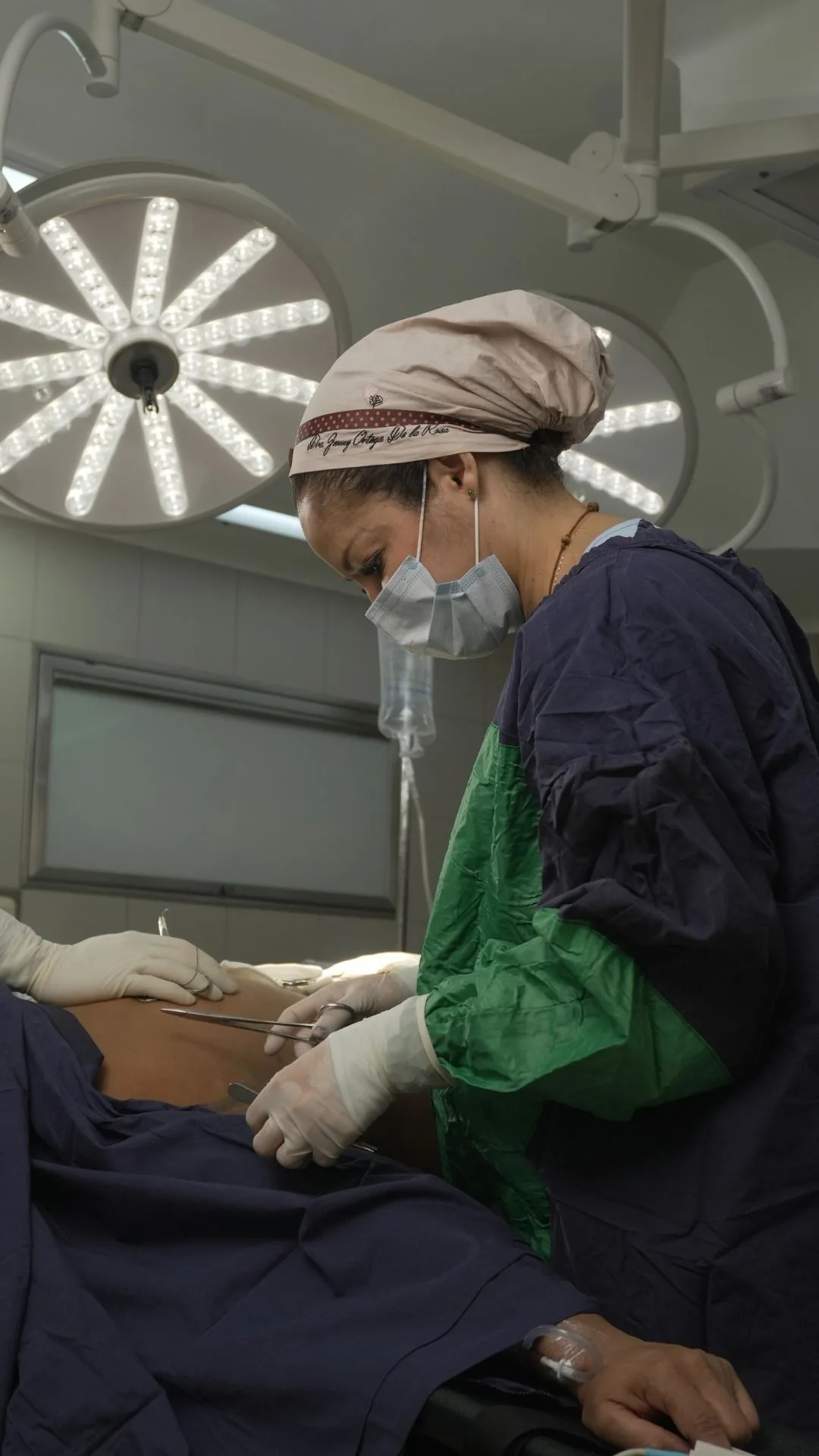
What are breast implants?
Breast augmentation — also known as augmentation mammaplasty — is the most commonly performed cosmetic surgical procedure worldwide. It uses silicone gel implants placed beneath the breast tissue or chest muscle to increase volume, improve shape, and restore symmetry. The goal is never to impose a standard look, but to achieve a result that feels proportionate, natural, and completely consistent with each patient's body and personal aesthetic.
Modern silicone gel implants bear no resemblance to the liquid silicone devices of earlier decades. Today's implants use cohesive silicone gel — a material that holds its shape even if the shell is compromised — combined with textured or smooth shells engineered to minimize complications. The result in your hands feels remarkably similar to natural breast tissue: soft, with natural movement, and with no palpable edges in well-selected candidates.
At my practice in Buenos Aires I work exclusively with implants that carry both FDA clearance and ANMAT certification (Argentina's national regulatory agency), so that every device meets rigorous international quality and safety standards. Brand selection — Motiva, Mentor or Allergan — is made together with each patient based on her anatomy, skin quality, and desired outcome.
Buenos Aires is an established destination for cosmetic surgery, offering high-level surgical care with a board-certified surgeon. International patients recover in neighborhoods like Palermo and Recoleta, with direct follow-up care at the clinic throughout their stay.
Types of implants
Choosing the right implant is the most important decision in achieving a natural-looking result. The selection considers shape, profile, surface texture, and size — all in relation to your chest width, breast base diameter, skin quality, and personal goals.
Shape: round vs. anatomical
Round implants provide fullness in both the upper and lower pole of the breast. They create a lifted appearance and are the most versatile option, suitable for the majority of patients. When placed correctly, round implants can look entirely natural, with upper pole fullness that softens with movement. Anatomical implants (teardrop-shaped) are indicated when a more gradual, natural-slope silhouette is desired, or when the patient has minimal native breast tissue and requires a more precisely shaped result.
Profile: low, moderate, high, ultra-high
Profile refers to how far the implant projects forward relative to its base diameter. Patients with a narrower chest and smaller breast base typically benefit from a moderate to high profile to achieve visible volume without exceeding the natural width of the breast. Patients with a broader chest and wider breast base often prefer a low to moderate profile for a more subtle, proportionate result.
Surface: smooth vs. textured
Smooth implants move freely within the pocket, mimicking natural breast movement. Textured implants have a slightly rougher surface designed to encourage tissue adherence and reduce movement. The choice depends on placement plane, implant shape, and individual anatomy. Both options are safe and have strong long-term track records. I discuss the optimal choice for your specific case at the consultation.
Brands: Motiva, Mentor, Allergan
All three brands are FDA-cleared and ANMAT-certified for use in Argentina. Motiva implants feature patented ProgressiveGel technology with ultra-cohesive silicone and a nanotextured surface. Mentor (J&J) and Allergan (AbbVie) are among the most extensively studied implant brands, with decades of clinical data on their safety and durability. The specific brand used in your procedure is selected based on availability, anatomy fit, and the result you are seeking to achieve.
Who is a candidate?
Breast augmentation is indicated for patients who wish to increase breast volume, improve symmetry, or restore breast fullness lost after pregnancy, breastfeeding, or weight loss. The ideal candidate is in good general health, has realistic expectations, and understands that the result will be personalized to her anatomy rather than matching a standard template.
- Women who feel their breast size is disproportionately small relative to their figure
- Patients with marked breast asymmetry (different sizes between left and right)
- Women who have experienced volume loss after pregnancy and breastfeeding
- Patients who lost significant breast volume following major weight loss
- Women with a tuberous or constricted breast base who require volume and shape correction
- Patients who want to combine augmentation with a breast lift (augmentation-mastopexy) for sagging and volume loss simultaneously
- Good general health, non-smoker or willing to stop smoking 4–6 weeks before surgery
- Stable weight and completed desired pregnancies (not a strict requirement, but ideal)
Breast augmentation is not recommended for patients with active breast infections, unresolved breast pathology, or unrealistic expectations about results. At the consultation, I review your full health history, perform a breast examination, take measurements, and use 3D imaging when available to help you visualize the expected result before surgery.
Consult your case today
In 30 minutes we evaluate your anatomy, review your goals, and I explain exactly which implant and technique is right for you.
Contact via WhatsAppThe procedure step by step
Breast augmentation is performed under general anesthesia and typically takes 1 to 2 hours. It is done as an outpatient procedure or with a one-night stay depending on the complexity and whether it is combined with a breast lift or other procedures.
-
1Preoperative planning Full breast examination, measurements of chest width and breast base diameter, skin quality assessment, and implant size simulation. We define implant brand, shape, profile, and surface together. Preoperative lab work and anesthesia clearance are coordinated.
-
2Incision placement The preferred incision is the inframammary fold — a short horizontal incision made in the natural crease beneath the breast. This approach provides direct access to the pocket, precise implant positioning, and favorable scar concealment. The incision heals in the fold and is hidden by the breast itself. Periareolar and transaxillary approaches are available for specific cases.
-
3Pocket creation: subfascial or submuscular The implant is placed either subfascially (beneath the pectoral fascia, above the muscle) or submuscularly (partially beneath the pectoralis major muscle). The subfascial plane offers natural breast movement and faster recovery with less pain. The submuscular plane provides additional coverage over the upper pole and is preferred for very thin patients with minimal native breast tissue. The choice is individualized at the consultation.
-
4Implant placement and symmetry check The implant is carefully positioned in the pocket using a no-touch technique to minimize contamination risk. The patient is placed in a sitting position intraoperatively to assess symmetry, implant position, and fold height before final closure.
-
5Closure and recovery room Incisions are closed in multiple layers with absorbable internal sutures. A supportive surgical bra is applied immediately. The patient recovers in the recovery room for 1–2 hours before discharge or transfer to overnight accommodation.
Recovery week by week
Recovery from breast augmentation is very manageable, especially with the subfascial technique. Most patients describe the first 48 hours as the most uncomfortable, with tightness and pressure rather than sharp pain. Here is what to expect at each stage:
- Days 1–3: tightness, swelling, and mild to moderate discomfort managed with oral medication. Sleeping with the upper body slightly elevated. Limited arm movement — avoid lifting above shoulder height.
- Days 4–7: significant improvement. Most patients are mobile and comfortable at home. Sutures are internal and absorbable — no removal needed. Light walking encouraged.
- Week 2: return to desk work and most daily activities. Driving may resume when comfortable. Sports bra worn continuously.
- Weeks 3–4: return to light exercise (walking, stationary cycling). Avoid impact sports, heavy lifting, or chest exercises.
- Week 6: full return to all exercise including upper body workouts. Transition from sports bra to underwire bra if preferred.
- 3–6 months: the drop and fluff process completes. Implants settle into their final position, the upper pole softens, and the natural shape emerges. The full result is not visible until this settling is complete.
Immediately after surgery, implants sit high on the chest due to muscle tension and swelling. Over 3–6 months they gradually descend into the pocket and the gel redistributes, creating natural lower pole fullness and a softer upper pole. This settling process is normal and expected. Final photos are taken at 6 months, not at 6 weeks.
Results
The goal of breast augmentation at my practice is always a natural, proportionate result that enhances — not overpowers — the patient's figure. I do not work toward a single aesthetic ideal. Instead, I aim for a result that looks like it belongs to your body: the right volume, the right shape, and the right projection for your chest width, waist, and hips.
With modern cohesive gel implants placed through a well-planned approach, the results are:
- Natural in appearance: no visible implant edges, no unnaturally spherical upper pole, movement consistent with natural breast tissue
- Natural in feel: cohesive gel mimics the softness and weight of natural breast tissue, especially in the subfascial plane
- Made to last over time: modern implants have a manufacturer-estimated lifespan, assessed individually, with no mandatory replacement schedule. There is no mandatory replacement at 10 years.
- Stable over time: unlike volume loss from weight fluctuation, implants maintain their shape regardless of body changes
The implant volume added by breast augmentation tends to remain stable over time. However, aging, gravity, pregnancy, and weight changes continue to affect breast shape over time. Patients who later develop ptosis (sagging) can address this with a breast lift, either performed simultaneously at the first surgery or as a secondary procedure years later.
Cost of breast augmentation in Buenos Aires
The fee for breast augmentation with Dra. Jenny Ortega De La Rosa in Buenos Aires depends on implant brand and model, technique (subfascial vs. submuscular), whether a breast lift is included, and whether surgery is combined with other procedures. As a personalized medical service, we do not publish prices — everything is arranged during the initial consultation.
- Dra. Jenny's surgical fees
- General anesthesia
- FDA & ANMAT certified implants (Motiva / Mentor / Allergan)
- Operating room and surgical supplies
- Preoperative consultations and post-op follow-up appointments
- Surgical bra included
- Post-op care at the clinic during recovery
In Buenos Aires, breast augmentation is performed with internationally certified implants, in an accredited operating room, and with personalized postoperative follow-up at every stage. International patients typically stay 10–14 days, covering surgery and the initial recovery period before returning home.
Request your personalized quote
Send your photos via WhatsApp and within 24 hours I will respond with a preliminary evaluation and the cost range for your anatomy and goals.
Inquire about priceFrequently Asked Questions about Breast Augmentation
Most patients return to desk work and light daily activities within 7–14 days. The first 48–72 hours involve tightness and mild to moderate discomfort, managed with oral medication. Sports and upper body exercise are restricted for 4–6 weeks. The final result — after the implants fully settle — is visible at 3–6 months.
The inframammary fold incision is placed in the natural crease beneath the breast, hidden by the breast itself in all positions — standing, lying down, and in a bikini. With proper scar care and sun protection during the first year, the scar fades to a thin, pale line that is virtually invisible. Most patients cannot locate it within 12–18 months post-surgery.
Yes, in the vast majority of cases. The inframammary fold approach does not interfere with breast glandular tissue, milk ducts, or nipple sensitivity. Both subfascial and submuscular placement preserve breastfeeding capacity. We discuss your plans for future pregnancies at the consultation so that the surgical plan is designed accordingly.
No. Modern cohesive silicone gel implants (Motiva, Mentor, Allergan) do not have a mandatory replacement schedule. You are not obligated to change implants at 10 years. Replacement is only necessary if a complication occurs — such as rupture or capsular contracture — or if you choose to change size or profile. Implant durability is estimated by the manufacturer and assessed individually at each follow-up. Routine breast imaging (ultrasound or MRI) is recommended periodically to monitor implant integrity.
The fee is defined during the in-person valuation consultation with Dr. Jenny, based on each patient's needs. As a personalized medical service, we do not publish prices — everything is arranged during the initial consultation.
Ready to take the next step?
Book your consultation today. We assess your anatomy with no commitment and I explain exactly what we can achieve together.
Book consultation via WhatsAppSee results at @dra.jortegadelarosa